Young Actors Are Shutting Down Hollywood's Creepiest Audition Traditions — And the Industry Is Finally Listening
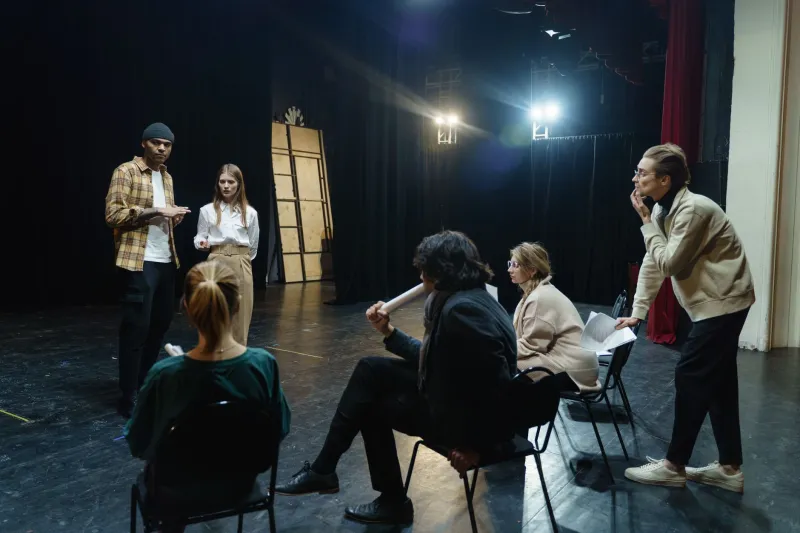
For decades, the audition room was treated like a private kingdom. Whatever happened inside stayed inside. Young hopefuls were expected to be grateful just for the opportunity — no questions asked, no boundaries drawn. But something has changed. A generation of performers raised on social media transparency, #MeToo accountability, and a genuine belief that their personal safety isn't negotiable is rewriting those unspoken rules from the ground up.
And honestly? Hollywood is starting to blink first.
The Old Playbook Is Getting Torched
If you grew up watching any kind of behind-the-scenes Hollywood content, you've probably absorbed the mythology: the young actor, alone in a room, doing whatever it takes to land the part. That mythology wasn't accidental. It was carefully constructed to normalize a power imbalance that benefited exactly one side of the equation.
Today's emerging actors — many of them in their late teens and early twenties — aren't buying it. They've watched the documentaries. They've read the exposés. They've seen what happened to the generation before them, and they're not interested in repeating it.
"There's this assumption that desperation is part of the job," one 22-year-old actress who recently relocated to Los Angeles from the Midwest told a theater community podcast earlier this year. "Like, you're supposed to want it so badly that you'll tolerate anything. But I don't think that's strength. I think that's a trap."
Virtual Auditions Changed Everything — And Nobody Wants to Go Back
The pandemic accidentally handed young performers a massive piece of leverage: the virtual audition. When in-person meetings became impossible, casting directors adapted. Zoom callbacks became standard. Self-tape submissions exploded. And somewhere in the middle of all that logistical chaos, actors realized something important — they felt safer.
Not just physically safer, though that matters. Emotionally safer. More in control. Able to perform without the ambient pressure of being physically alone in a room with someone who held enormous power over their career.
Now, a growing number of young actors are specifically requesting virtual options even when in-person meetings are back on the table. Talent agencies are reportedly fielding more of these requests than ever before, and several mid-size casting firms have quietly made virtual first-round auditions a permanent default — not because they were forced to, but because it's become a competitive advantage in attracting younger talent.
The math isn't complicated: if your process makes performers uncomfortable and a competitor's process doesn't, you're going to lose access to the best emerging talent. Simple as that.
The Chaperone Comeback
Here's something that would've been laughed out of certain Hollywood circles five years ago: bringing a support person — a parent, a friend, a manager, literally anyone — into an audition or a meeting with a producer.
The stigma around that used to be brutal. Bring your mom to a callback and you were immediately labeled difficult, immature, not serious. The message was clear: real professionals handle things alone.
That stigma is eroding fast. Several young actors have spoken publicly about normalizing the presence of a support person at meetings, particularly early-career meetings where power dynamics are the most lopsided. Organizations like SAG-AFTRA have also pushed harder in recent years to remind performers — especially minors and young adults — that they have every right to bring someone with them.
What's interesting is how casting directors themselves are increasingly responding to this shift. Rather than viewing chaperones as a red flag, many are now treating a performer's comfort level as a genuine factor in the room. A relaxed, confident actor gives a better audition. That's not idealism — that's just practical reality.
Calling It Out Publicly: The Nuclear Option That's Actually Working
Perhaps the biggest shift of all is the willingness of young performers to go on record. Not in vague, anonymous terms — but specifically, with names and details, posted directly to social media or shared with entertainment journalists.
This is the move that genuinely terrifies the old guard. The traditional industry response to misconduct was containment: quiet settlements, blacklisting, reputation management. That playbook depends entirely on silence. And Gen Z, as a cohort, is not particularly interested in staying silent.
Over the past two years, several emerging actors have shared accounts of inappropriate audition behavior across platforms like TikTok and Instagram — sometimes naming casting directors or production companies directly. The legal risks of doing so are real, and plenty of entertainment attorneys will tell you it's a complicated road. But the cultural impact has been undeniable.
At least three casting directors have faced industry-wide scrutiny following social media call-outs from young actors in the past eighteen months alone. Two of them lost significant studio contracts. That outcome would have been nearly unthinkable a decade ago.
What the Studios Are Actually Changing
Behind closed doors, some genuine policy movement is happening — though skeptics will fairly note that it's moving slower than it should.
Several major production companies have updated their audition conduct guidelines to explicitly prohibit one-on-one meetings between adult casting personnel and minor performers without a guardian present. Some studios have introduced anonymous reporting systems specifically for audition misconduct — separate from general HR channels, which young actors have historically been reluctant to use out of fear of career retaliation.
There's also been a quiet expansion of what SAG-AFTRA calls "intimacy coordinator" adjacent roles — professionals brought in not just for on-set scenes but increasingly for audition processes involving sensitive material. It's a small shift, but it signals that at least some corners of the industry are taking the structural problem seriously rather than treating individual bad actors as isolated incidents.
The Bigger Picture
None of this means Hollywood is fixed. Anyone telling you the audition room is now a completely safe and equitable space is selling something. The power imbalances are deeply baked in, and they don't disappear because a few casting firms updated their Zoom policies.
But what's genuinely different right now is the direction of pressure. For most of Hollywood's history, the pressure ran one way — downward, onto the performer, to comply and be grateful. Today, there's real counterpressure coming from below, and it's being applied by a generation that understands collective leverage in a way their predecessors simply didn't.
They grew up watching fandoms organize online. They understand that visibility is power. And they've decided — collectively, loudly, and with increasing effectiveness — that the audition room doesn't get to be a lawless zone anymore.
Hollywood can adapt or it can keep losing its best young talent to people who will. Given the industry's current anxiety about finding the next generation of bankable stars, that's not really a choice at all.